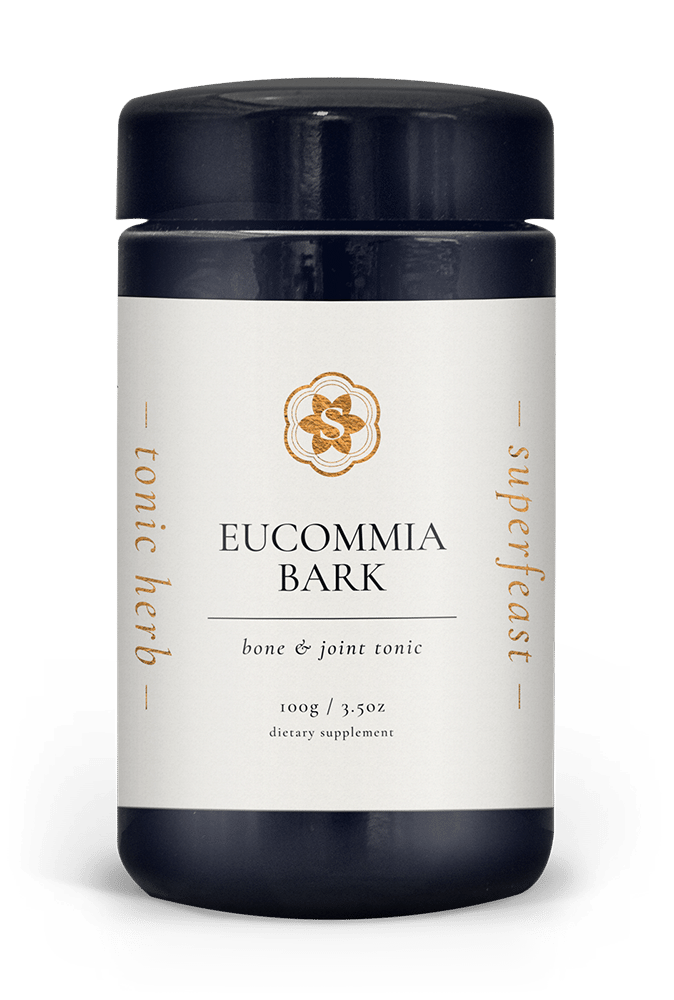
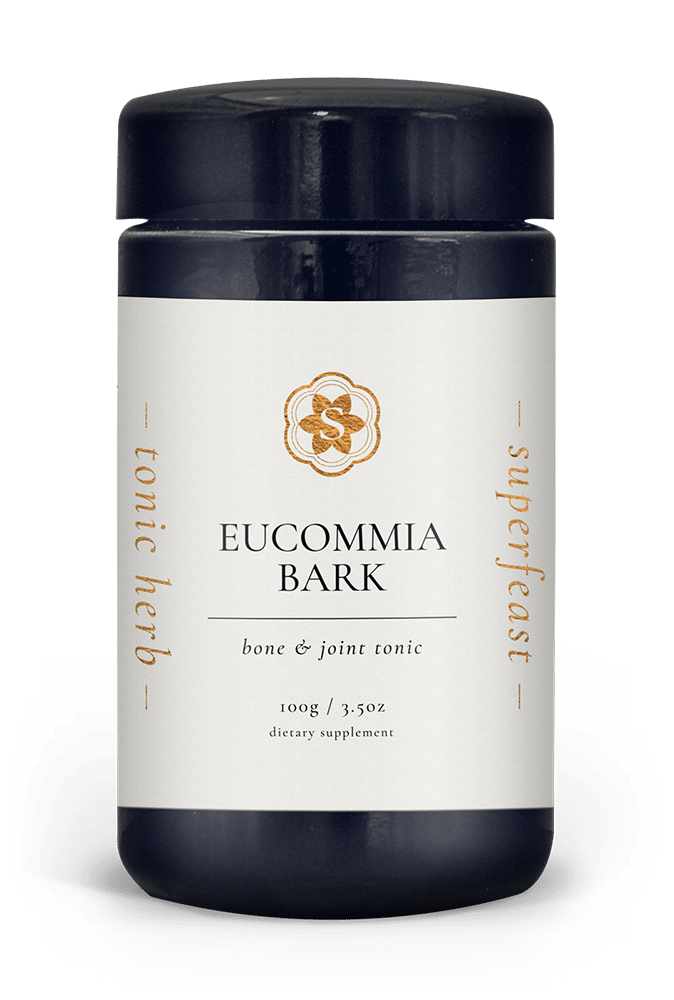
There are herbs I educate on and ‘sell’, and then there are certain herbs I personally love and live with. Eucommia bark, known in Chinese medicine as Du Zhong, is definitely in the second category for me. It's one of the herbs I talk about with honest conviction, not because I've memorised the research, but because I've felt it work in my own body in ways that are hard to put into words.
A Fractured Foundation
Many years ago I sustained a fracture to the L1 vertebrae in my spine.
For anyone who has dealt with a spinal injury, you'll know it's not just physically debilitating, it shakes the confidence in your body at a fundamental level for years or potentially your whole life. I was looking for support that went beyond surface assistance. I needed something that could work at the level of the bones, the connective tissue, the deep structural integrity of the body. For over 20 years I suffered with a compromised spine.
Eucommia, The Cornerstone of my Recovery.
In Traditional Chinese Medicine, Eucommia (Di Zhong) is considered one of the premier Yang / Jing tonic herbs. Jing, at its most physical level, governs the bones, the spine, the marrow, and the deep constitutional reserves of the body. It is understood as a tonic herb that strengthens structural tissue and improves structural competency at a fundamental level. The classical texts speak of it tonifying the Liver and Kidneys, strengthening the sinews and bones, and specifically addressing lower back pain and weakness, which is precisely what I needed. In using Eucommia I didn't receive miraculous overnight change, It was a gradual, steady repair. Over weeks, months, years, I've felt a return to structural resilience that I hadn't experienced since before the injury. My back has become more stable and less fragile. The deep ache’s quietened. I'm now moving through the world with more ease and less fear of my own body.
Chronic Fatigue / System Collapse
Thirteen years ago, shortly after the birth of my son, I was hit with serious chronic fatigue. If you've experienced it, you'll know it's not just tiredness, it's a full-system collapse. You get the flu, it doesn't go away for months, you’re exhausted all the time. Energy, clarity, motivation, immune function all of it depleted in ways that are difficult to explain to someone who hasn't lived it.
What I now understand, both personally and through learning to understand these herbs on a more profound level, is that what was happening was a major disruption of my HPA axis the hypothalamic-pituitary-adrenal-thyroid axis that governs how the body responds to and recovers from stress. HPA axis dysfunction has been found in a high proportion of people with chronic fatigue. Over time, chronic stress alters the way cortisol, adrenaline and other stress hormones communicate with the body, making it harder and harder to return to a relaxed baseline.
This is where Eucommia, and a few other superior herbs became part of a broader tonic herb practice that led me into a level of reverence for these traditions and revelation on the power of plants and their ability to work as allies and true healers for humans incarnated on this amazing planet.
Research into Eucommia ulmoides has highlighted its action on the neuroendocrine-immune network, including the HPA, HPT, and HPG axes, the very interconnected systems that govern stress response, immune regulation, hormonal balance, and energy metabolism. This is a natural medicine translated through empirical use into ancient wisdom, now increasingly supported by contemporary science that's beginning to catch up with what Daoist herbalists understood thousands of years ago.
Adaptogenic herbs like Eucommia Bark (Du Zhong) work not by pushing the body in one direction, but by regulating the system, helping an overworked system find its way back to balance, helping an under-functioning system find its way back to vitality, helping us to adapt gradually with time and consistency. They act on the HPA axis and may improve reproductive hormone regulation, immune support, mood, and mental stamina. For me, this meant a slow but unmistakable return to functional energy, to clearer thinking, to the feeling that my kidneys (in the TCM sense) were being nourished and restored rather than further depleted.
Du Zhong in the Daoist Tradition
Eucommia bark has been revered in China for over two thousand years. The tonic made from its bark has been used in China for over 2,000 years, purportedly to promote longevity, nourish the Kidneys and Liver, strengthen joints and the back, and prevent miscarriages.
In TCM it is considered a perfectly balanced Yin/Yang tonic known both as a powerful Yang and Jing tonic herb, and noted for its ability to support the skeletal and endocrine systems. The name Du Zhong itself is said to derive from a legendary figure who took the herb, cultivated himself deeply, and became enlightened; the herb was named in his honour. This is the Daoist tradition at its finest: plants as teachers, as allies, as agents of transformation.
One of the most beautiful expressions of Du Zhong's nature lies in the Doctrine of Signatures. Being a flexible tree in nature when a leaf is torn, elastic strands of rubber hold the two pieces together; it is understood by traditional herbalists to confer strength and flexibility to the body. The tree itself embodies what it gives.
In Daoist herbalism, Du Zhong targets the Kidney and Liver meridians. The Kidneys governing deep constitutional energy, reproduction, bone health, and the aging process; the Liver governing the free flow of Qi and the regulation of emotions. This dual action makes it a remarkable herb for anyone dealing with structural weakness, fatigue, hormonal dysregulation, or the cumulative depletion that comes with a demanding life. This list of this one herb’s active constituents and medicinal capabilities are near miraculous. This is the reason it is considered a superior herb by the Daoists and has been revered for millennia.
A Tree on the Edge, The Conservation Story
Eucommia ulmoides is now as near threatened or vulnerable in the wild, with wild resources on the verge of extinction and habitat ranges shrinking due to over-exploitation and global warming and a shift in micro climates that were optimal for its growth. The same remarkable quality that makes the tree medicinally and industrially valuable, its latex, which produces a unique form of rubber is what nearly drove it to the edge.
Because of low production and high demand for natural rubber in China, a unique process was developed to manufacture elastic materials from Eucommia gum as substitutes for conventional rubber products. The tree grows naturally across the mountainous regions of central China Hunan, Sichuan, Shaanxi, and Guizhou among them and it remains the only temperate-zone tree ever used in commercial rubber production. The industrial pressure on wild populations has been enormous. The medicinal use of Du-zhong has played a significant role in helping the species regenerate its numbers, primarily by driving widespread cultivation to meet demand, although its wild population remains threatened.
Eucommia ulmoides is now classified as a national second-class rare and protected plant in China. Today, essentially all Eucommia used medicinally comes from cultivated sources.
This is why sourcing matters so deeply. At SuperFeast, we don't simply buy from the nearest supplier, we trace our Du Zhong to specific growing regions where cultivation is done with integrity, where the trees are given time to mature properly, and where the bark is harvested in a way that supports regeneration rather than extraction. This is Di Dao sourcing - sourcing from the spiritual homeland of the herb, with reverence for the plant, the land, and the people who tend both.
What I've Seen in Others
In my years working as a rep and educator for SuperFeast, Eucommia Bark is one of the herbs I return to again and again when communicating with practitioners and customers. I've seen it work remarkably well for:
- People with lower back pain, disc issues, and post-injury recovery
- Women navigating perimenopause and hormonal depletion
- Men dealing with fatigue, low libido, and loss of structural strength
- People in burnout who need deep, slow restoration rather than stimulation
The consistency of the feedback is what moves me. This isn't placebo, it's a herb with millennia of use, an increasingly robust body of modern research, and the lived experience of millions of people who have found their way back to themselves through it. It's one of the primary herbs in SuperFeast’s Jing blend.
Why It's One of My Favourites
I've worked with a lot of herbs. I have deep respect for many of them. But Eucommia holds a special place because it met me in some of the most difficult periods of my life. It truly supported my journey with a fractured spine and a body in chronic depletion and it’s honestly helped me rebuild from the ground up.
It is a herb for the long game. A genuine tonic, in the deepest sense of that word for those that are truly in need. Something that feeds the root so the whole tree can stand tall.
If you haven't explored it yet, I'd genuinely encourage you to. And if you'd like to learn more about how Eucommia Bark and the broader SuperFeast range can support your health or your customers, I'm always here to help.
Nic is the National Sales Representative and Educator for SuperFeast. He works with practitioners, retailers, and individuals across Australia to bring tonic herb wisdom into everyday life.